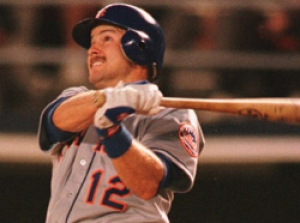
Kent arrived first and immediately was slotted into the lineup at third base, and Thompson came some weeks later. It was actually Thompson who was thought to be the five-tool superstar that the Mets coveted to play centerfield. However, Thompson would quickly turn out to be one of a number of those “five-tool hopefuls” the Mets would acquire over the years who would never live up to those expectations.
Kent was never expected to be anything special. While the Mets management was so focused on the excitement a special talent like Thompson would bring, Kent was going to be just another in the revolving door that was third base – a right handed-hitting power prospect. They figured he was another Joe Foy, Bob Aspromonte, Jim Fregosi, Joe Torre, Roy Staiger…you know the names.
But when Willie Randolph’s illustrious career suddenly tanked, Kent was moved to second base where he was chastised for his lack of range in the field. And regardless of how well he hit, he was never well-liked by management, and was actually disliked by the media. He hated any fanfare, he disliked attention. He just wanted to do his job and go home. He wasn’t there to make friends...just wanted to do his job and go home. A lot like Kevin McReynolds years earlier. And we know how that works out in New York City sports.
In just over four years, Kent averaged .279 with 16 home runs and 65 runs batted in. Not bad for a second baseman. But during the 1996 season, yet another Mets GM, Joe McIlvaine, decided to flip Kent for Baerga, the Cleveland Indians All-Star second baseman. It was a puzzling move and Baerga was a brutal bust.
Kent would leave the Mets and go on to a career in which he hit .290 and slammed 377 homers and drove in 1,518 runs.
Kent would play for multiple teams and was successful wherever he put on a uniform in what should have been a Hall of Fame career. He was a dominant force at the plate, and served as the protection for Barry Bonds in the San Francisco Giants line-up for a number of years. During a nine-year span with the Giants (six seasons), with the Houston Astros (two seasons), and his first season with the Dodgers, Kent averaged .295 at the plate with 28 home runs and 110 RBI. He won four Silver Slugger Awards, he was selected to play in five All Star Games, and he was the National League’s Most Valuable Player in 2000.
Given his numbers, given his longevity, given his quiet yet hard-nosed, old school approach every game, every season, it’s a wonderment as to why Kent has been snubbed by the HOF voters for so long.
But not anymore.
With all of his success throughout his career, it is noteworthy that his performance while in a Mets uniform, while productive, was not his best. Could it be because he was in the black hole that is the Mets second base position? Because it seems that every star the Mets acquired to man the position met their professional demise.
Nolan Ryan had numbers what were almost super human and played with four different Major League teams during his illustrious Hall of Fame career. But while he played in his only World Series with the Mets (1969), his stats, while respectable, were nowhere near on the level of his production with the other teams he played for.
So while Kent has the history of his time with the Mets in common with Ryan, he now shares the end result – membership in baseball’s Hall of Fame in Cooperstown.
Congratulations Jeff Kent!