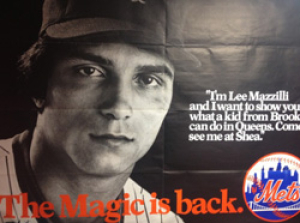
Lee Mazzilli was the face of the New York Mets during one of the darkest periods of the organization
Mazzilli was the face of the organization. With the exception of Doc Gooden, who had his image on the side of a Manhattan building, no other New York Mets player was so adorned throughout the five boroughs as Lee Mazzilli.
“I’m Lee Mazzilli and I want to show you what a kid from Brooklyn can do in Queens. Come see me at Shea.”
Mazzilli had the misfortune to arrive on the scene when Tom Seaver was about to be driven from Flushing by M. Donald Grant in 1976. Seaver would be gone on June 15, 1977 and Mazzilli would be the one who became the team’s poster boy – figuratively and literally.
Mazzilli played the premier position, centerfield, in the city that boasted the best centerfielders to ever play the game. He not only had matinee idol looks, but he had the tools to make it actually matter. He could hit, he could run, and he played centerfield using the Willie Mays patented basket catch.
Maz was the main offense…really the only offense…in the Mets lineup from 1978 through 1980. During that three-year period, he compiled stats of .273 BA, .353 OBP, 16 HR, 61 RBI, 20 SB in 1978; .303 BA, .395 OBP, 15 HR, 79 RBI, 34 SB in 1979; and .280 BA, .370 OBP, 16 HR, 76 RBI, 41 SB in 1980.
But then, for some reason, Joe Torre decided that he was going to convert Mazzilli into a first baseman. Torre had been a really good hitting catcher but eventually moved from behind the plate to third base and eventually to first base. While that move may have prolonged Torre’s career, that decision ruined Mazzilli’s career.
He never looked comfortable at first base, and he then became uncomfortable at the plate…totally losing his identity and looking lost. He was eventually traded away for Ron Darling and Walt Terrell in 1982, but would return in 1986 to play a key role in the Mets second World Championship.
Carlos Beltran is finally getting the recognition that he earned as a New York Mets player
Let’s get two things out of the way.
First…the Houston Astros sign stealing “scandal.” Before you say anything, please realize that Brett Gardner was banging a bat on the roof of the Yankees dugout during games LONG before reports about the Astros ever surfaced. And sign stealing has been a part of baseball since forever. Whether you are doing it from the second base bag, from the coaching boxes, or part of a relay from the centerfield bleachers, sign stealing has always been part of the game. Some people are just better at it than others. Get over it.
Second and most importantly…STOP with the “Strike Three” thing. It’s nonsense. There would never have BEEN that “Strike Three” if Beltran hadn’t carried the team on his back all season to get there. And other than his struggles at the very beginning of his first season with the club, there was never a more gifted and talented player during that time period. He was a five-tool player who played a Gold Glove centerfield.
Beltran could do it all – hit for average, hit for power…from both sides of the plate, he could steal a base, take an extra base, he was an exceptional fielder and covered a lot of ground in centerfield with a strong arm. Beltran wasn’t boisterous, he didn’t go jumping around, ripping teammates’ jerseys off their bodies, doing any over-the-top celebrations. He just went out and did his job and he was clutch.
Beltran is known for being one of the most productive switch-hitters in Major League Baseball, only Eddie Murray has more extra base hits as a switch hitter. The only other switch hitter in history with the combination of power and speed possessed by Beltran was Mickey Mantle. And Beltran could also play centerfield on par with Mantle as well. Beltran was the dynamic five-tool player teams coveted.
Beltran signed a free agent contract with the Mets and would hit .280 with an OBP of .369. He accumulated 878 hits, 208 of them doubles, 17 triples, 149 home runs - 374 extra base hits during 6 1/2 seasons. He also drove in 559 and scored 551 runs, while stealing 100 bases.
While Beltran had a great career with the Mets, he is unfortunately remembered more for the one time he failed, rather than the multitude of times he was so clutch.
Beltran hit 41 home runs and drove in 116 runs and scored 127, hitting .275 with a .388 OBP during the 2006 regular season. He also secured a Gold Glove award.
It is unfair and unjust that fans will forever tie Beltran to the “called strike three.” Instead, his No. 15 should be hung up beside some of the others at Citifield.
Bobby Valentine was no joke with the New York Mets
There are two managers who are revered in New York Mets history – Casey Stengel and Gil Hodges. Hodges is understandable. He took the Mets from the outhouse to the penthouse and finally made them respectable. Stengel was an absolute joke.
Bobby Valentine came along and was a part of the Mets system and then on Davey Johnson’s coaching staff, before leaving to take the manager’s job with the Texas Rangers, leaving before the ’86 championship season. Who knew it wouldn’t be until he returned to the club that the Mets would appear in their next World Series.
After the Mets fell to another one of their historic lows in the 90’s, Bobby V came in and helped turn the franchise around. And while he was a character, unlike Casey Stengel, Valentine was a winner.
Valentine was much like his mentor, Tommy Lasorda, a very upbeat and intense dugout presence. And he was always considered a “players’ manager” because he pretty much let the players play and got the most out of whatever talent a player had.
Valentine is third in Mets history in games managed (1,003) behind only Terry Collins (1,134) and Davey Johnson (1,012), wins (536) behind only Davey Johnson (595) and Terry Collins (551), and winning percentage behind only Davey Johnson (.588) and Willie Randolph (.544).
Valentine managed the Mets during some memorable times in Mets history – the last Subway Series in the 2000 World Series against the Yankees and the first game back after 9-11. Certainly all the more memorable than hiding in the corner of the dugout with sunglasses and a fake mustache.
It’s like any other club – why are some people voted in and others are kept out?
So now that they are in, let’s take a look at three players who are NOT in:
Let’s start with Ed Charles…The Glider. Charles came to the Mets later in his career but he gave the Mets clutch play, professionalism, and leadership. He was a key member of the 1969 World Championship team and he was a member of the organization in many capacities for the rest of his life. Why is he forgotten?
Sid Fernandez is probably one of the top 5 pitchers in New York Mets history and yet is never mentioned. Even though he wore the No. 50 longer than anyone, Mets fans still think of Benny Agbayani when they think of No. 50 in a Mets uniform. El Sid will probably go down in history as the most underrated, and undoubtedly the most underappreciated, Mets player ever.
Jacob deGrom was one of the most dominant players to ever don a Mets uniform. His numbers were comparable to Tom Seaver and Jerry Koosman, and better than Dwight Gooden’s and Ron Darling’s numbers. However, since deGrom is still active elsewhere, we’ll just have to wait and see.
And while we are on the subject of being honored how about three former Mets players who should have their number retired - Carlos Beltran (15); Gary Carter (8); Jacob deGrom (48)? And how about manager Davey Johnson (5)? That’s all for another story.